Welcome To Your Solution

Many businesses contend with problems they cannot yet perceive, or cannot quantify. EnnTech Solutions helps to identify overlooked inefficiencies, unseen bottlenecks, and latent opportunities, translating insight into strategic action and tangible results.

See What Traditional Training Misses

When a specific location or operation isn’t performing, and traditional training hasn’t solved the problem, it may be time for a different perspective. EnnTech Solutions recognizes the commonly overlooked issues that standard training programs often miss, drawing on over a century of customer service and industry experience to identify what’s really holding your business back.

At EnnTech Solutions, we believe every business has the potential to perform better. Our approach begins by looking beyond the obvious to uncover overlooked inefficiencies, hidden challenges, and opportunities that traditional methods often miss. Drawing on over a century of experience in customer service and business operations, we help organizations understand the root causes of their problems and identify practical strategies to improve performance, strengthen teams, and increase profitability.

We believe effective solutions shouldn’t always come with a hefty price tag. That’s why we connect businesses with valuable resources at no cost. Whether you’re looking to improve employee retention, streamline operations, strengthen your marketing, or overcome persistent challenges at a particular location, our goal is to provide clear direction and actionable solutions that make a difference.

The internet offers an enormous wealth of information and resources, but finding the right tools can be time-consuming and overwhelming. Discover practical resources to help your business work smarter, solve challenges, and uncover new opportunities. EnnTech Solutions connects you with useful tools and information, without adding to your budget.

  • Change management engagement plans.
  • Take the customer’s point of view.
  • Improve employee retention.
  • Attitude is everything.
  • The importance of maintenance and housekeeping
  • Relaxed welcome or highly engaged?
  • Grow Revpar faster
  • Refine your energy-saving plan often.
  • What to do with your labor budget inefficiencies.
  • Stop being so serious if you’re entertaining.
  • Food is a universal language.
  • The music makes a difference
Attitude

It's All About Attitude

Of course attitude is important, but there is much more to it than a script or a "5/15" rule.

A Smile Goes a Long Way: Every Interaction Matters

This point cannot be stressed enough: A smile can be heard over the phone just as easily as it can be seen by a customer across the sales floor. A positive attitude and welcoming demeanor should be present during every customer interaction, regardless of the circumstances.

From the team member who spends most of their time in the stockroom or kitchen to the owner or CEO, everyone representing your business should make an effort to greet and interact with customers with a genuine smile. Your position within the company doesn’t change that responsibility.

Customers don’t distinguish between departments, job titles, or levels of management. They see everyone as a representative of the business. Every interaction contributes to their overall impression of your company, and even a brief encounter can influence whether they choose to return.

Of course, customers may specifically ask to speak with a manager, but that doesn’t make the rest of the team any less responsible for creating a positive experience.

The phone is for me

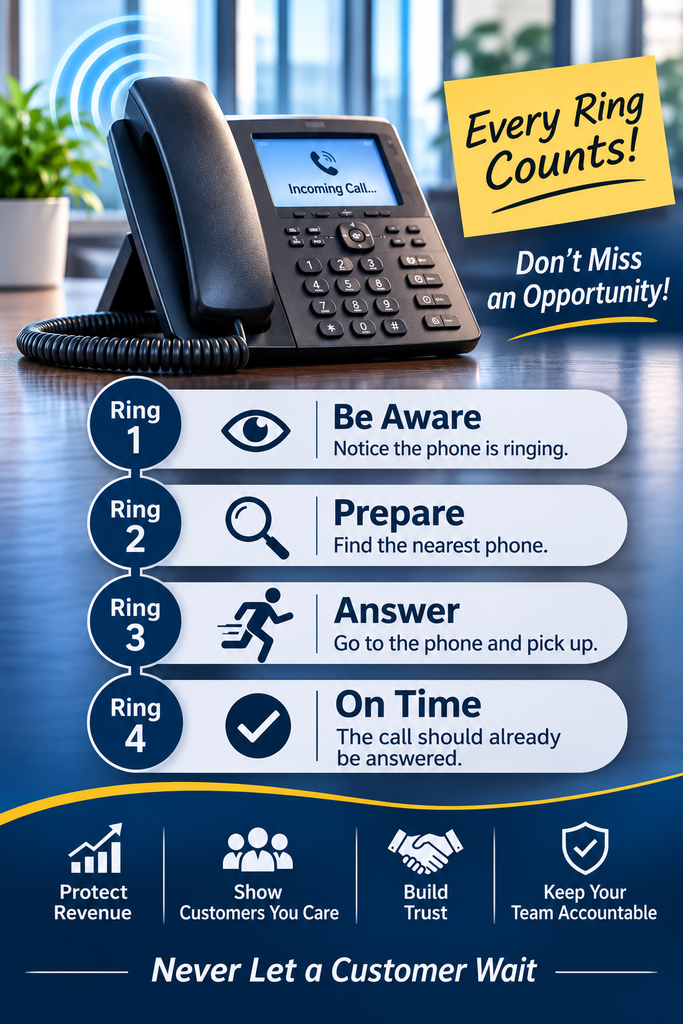
If you are in a place of business and hear the phone ring four or more times, that business is potentially losing revenue. It may not seem significant at first, but those missed opportunities add up over time, much like pennies accumulating in a jar.

Think of every ring as a potential lost customer—even the first one.

Managers, whether working on-site or visiting from a higher level of management, should be aware of their team’s phone-answering habits. Every available team member should take responsibility for answering incoming calls as quickly as possible. A ringing phone is an opportunity to connect with a customer, address a need, and potentially generate revenue.

Managers should always be conscious of incoming calls, but that doesn’t mean they need to personally answer every phone. Instead, they should establish clear expectations and guidelines that encourage the entire team to take responsibility.

A practical guideline for answering the phone as an on-site manager:

  • Ring 1: Be aware that the phone is ringing.
  • Ring 2: Identify the nearest available phone and prepare to answer.
  • Ring 3: Move to the nearest phone and answer the call.
  • Ring 4: The phone should already have been answered.

I can do that

It’s a simple mindset: “I can.” Yet, it’s surprisingly easy to lose sight of it as responsibilities grow. You don’t have to do everything, nor should you. Depending on your position, much of your time may be spent walking the floor, communicating with employees, and overseeing operations. There simply won’t always be time to handle every task yourself.

However, you should never ask a subordinate to do something you wouldn’t be willing to do yourself. Leadership isn’t about being above the work; it’s about setting the example. A district or area manager who takes the time to clean a bathroom, for example, will likely be remembered and talked about for years—not because it was their responsibility, but because they were willing to step in and help.

Just as importantly, you should encourage and promote that same “I can” attitude throughout your team. When employees see leadership willing to roll up its sleeves and help, it builds respect, strengthens teamwork, and creates a culture where no task is considered beneath anyone.

  • It can be heard in your voice
  • If you can be seen by a customer / guest, they can see it
  • It takes 100 of them to replace a single frown
  • All available team members should try to answer the phone as soon as it rings
  • All managers need to be trying to answer the phone at the second ring
Practical steps for managers answering the phone
  • Lead by example
  • Don’t be arrogant
Appearance

As a Customer, What Do You See?

Many managers become "Site Blind" after spending enough time working at a location and no longer have the viewpoint of a customer.

No empty sales spots

Even with seasonal changes in retail, empty shelves and displays should be kept to an absolute minimum. Avoid removing products from shelves or displays unless you have something ready to replace them. A store should always look active, organized, and well-stocked, even during seasonal transitions.

It doesn’t take much to create the wrong impression. A few empty shelves near the front of a store or a partially empty pie case can be enough to make customers start asking an uncomfortable question: “Is this location closing?”

That may seem like a small concern, but customer perception matters. Empty displays can suggest declining business, limited selection, or a lack of attention to the operation. Even if none of those things are true, the impression can still affect customer confidence and purchasing decisions.

Keep the food hidden unless you’re selling it

Customers should rarely, if ever, see an employee eating while working. Unless they happen to walk past the break room, eating should remain out of the customer’s sight and hearing. Employees should never be eating at a cash register, on the sales floor, or behind a front desk.

Beyond the obvious concern that food crumbs can attract insects and create sanitation issues, eating while working can interfere with customer service in several ways. There is no way to predict when the phone will ring, and an employee with a mouthful of food cannot properly or promptly answer a call. Likewise, there is no way to know when a customer will enter an employee’s immediate area and require assistance. An employee who is still chewing or swallowing is not in the best position to provide an immediate, professional response.

Employees should always be prepared to acknowledge customers, answer incoming calls, and respond to requests for assistance. Eating can wait until an appropriate break or designated area.

Staying on Your Feet: The Importance of Being Engaged

Employees may view the ability to sit while working as a benefit, or even believe it makes them more efficient. However, in a sales-driven environment, sitting can create the wrong impression. Customers may perceive an employee who is sitting behind a counter or sales desk as disengaged, uninterested, or simply unwilling to help.

Consider a retail environment: Every store has slower periods, and team members assigned to registers or cash wraps will inevitably experience times when there are no customers to assist. This is precisely why backup tasks should always be assigned. Employees should have a clear understanding of what needs to be done when customer traffic slows down.

Even when business is busier than expected, those tasks don’t disappear. A team member who is sitting may need to take extra time to stand, reposition themselves, or turn around to complete a task. These small interruptions can become unnecessary obstacles to maintaining productivity and staying engaged.

A Vice President of Operations for a large national hotel management company once made a rather memorable statement about this very subject:

“A stool breeds laziness, and laziness needs to be broken. If I see a stool behind the front desk at one of my hotels, that stool gets taken out into the parking lot and broken along with the laziness.”

Now, please don’t start breaking furniture in front of your employees! That comment was made in the late 1990s, and management approaches have certainly evolved since then.

Who are the employees?

“Do you work here?” is a question customers will sometimes ask even when an employee is wearing a complete company uniform and name tag. This is a clear indication that appearance alone isn’t enough to communicate that someone is available to help.

It’s important to establish and maintain a standardized dress code so customers can easily identify employees. However, just as important is making sure employees actively engage with customers rather than waiting to be approached.

Employees should make eye contact, offer a friendly greeting, and ask customers if they need assistance before those customers feel the need to ask, “Do you work here?”

Team Care

Team Members Are People Too

There should be regular check-ins with team members for productivity as well as for mental and physical health.

Are you asking too much of your team?

Here are answers to some of the questions we’ve been asked the most.

Business Blog coming soon.